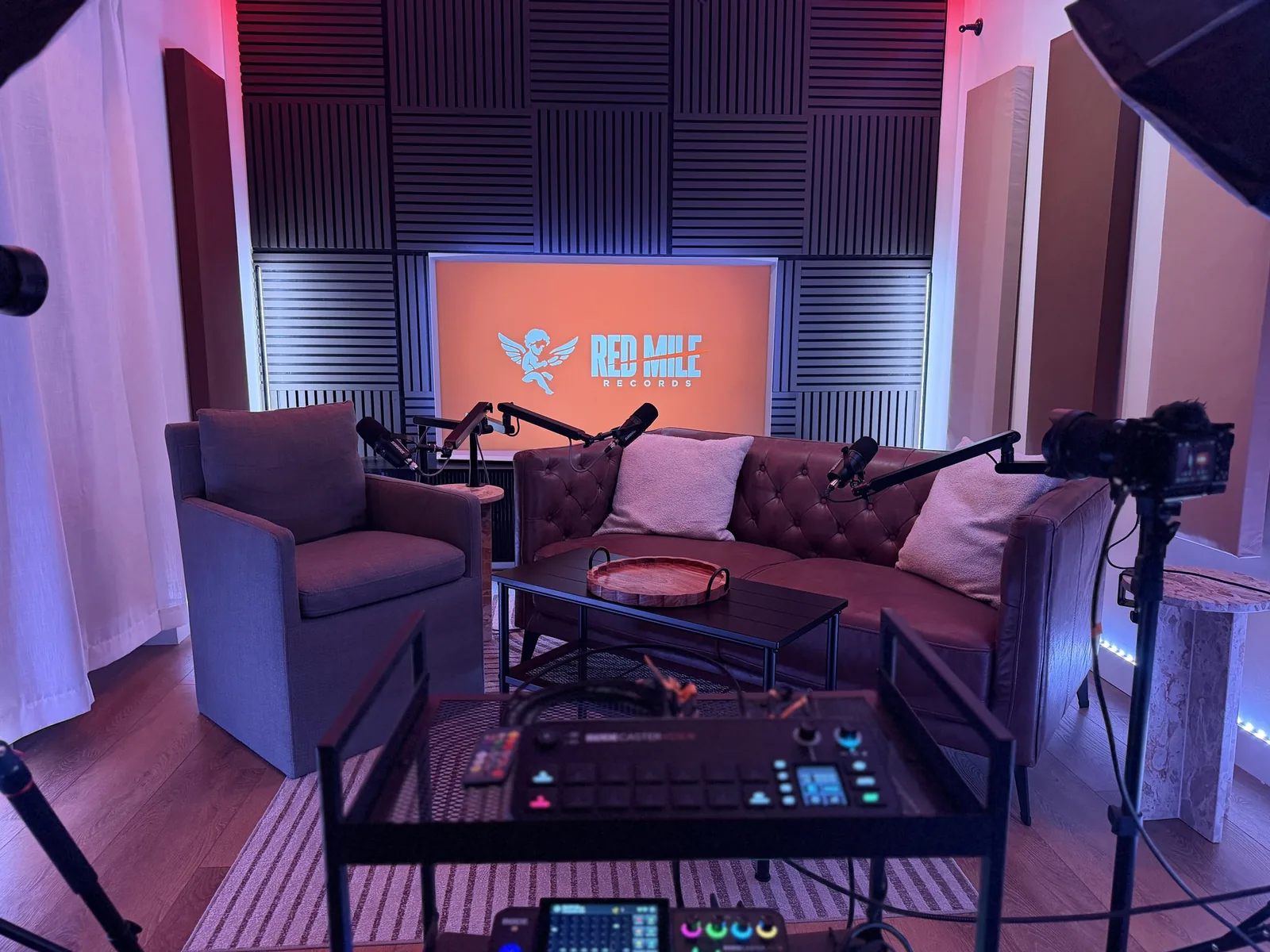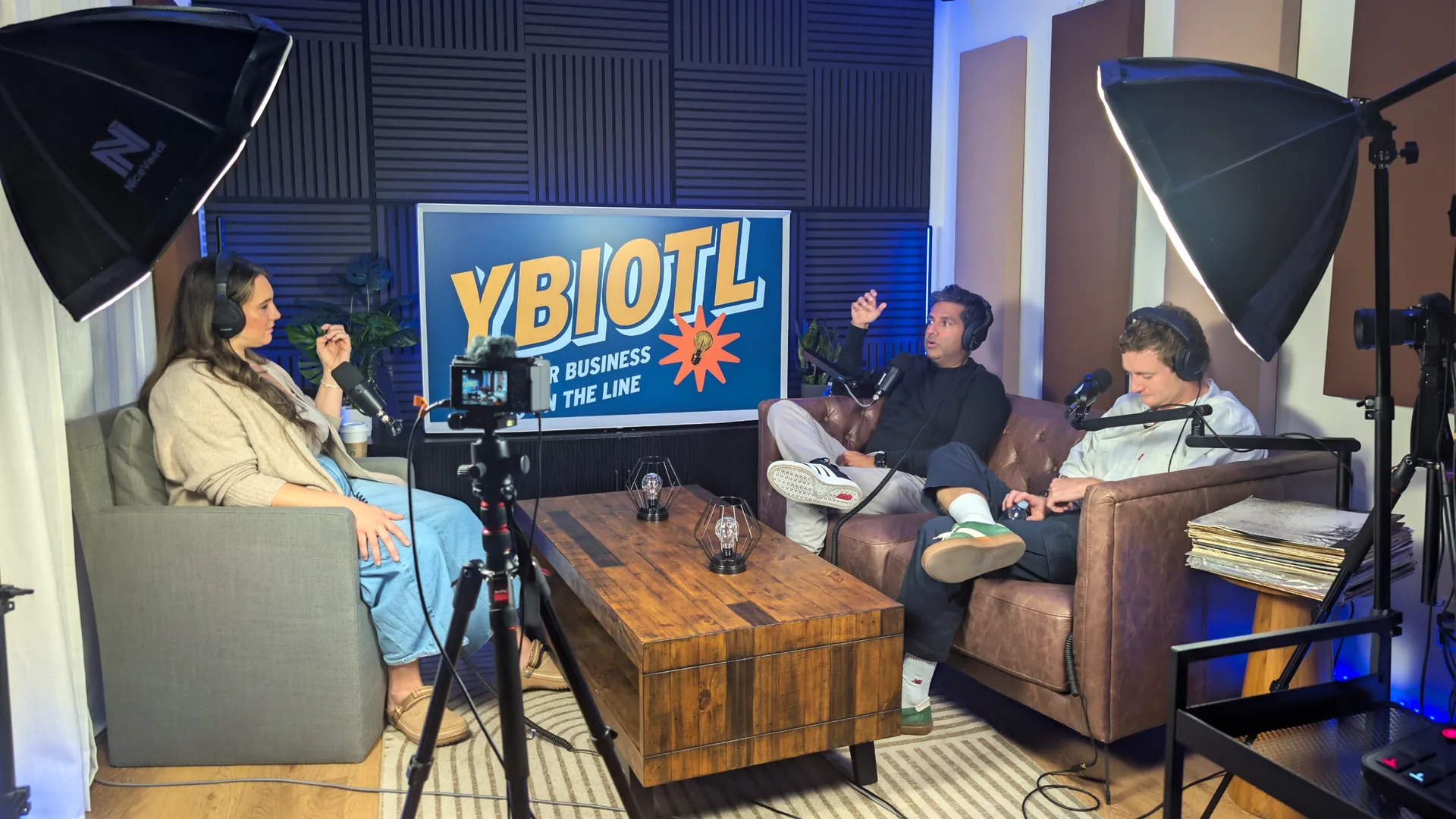
The short answer: as many people as you have microphones for. At Red Mile Records that number is four, set by four Shure MV7X microphone positions and the acoustics of the room. Four people record on mic, up to two more can sit in without recording, and anyone past that joins remotely on their own track.
That is the real constraint, and almost nobody says it out loud. People ask how many guests a podcast can have as though there is an editorial rule about it. There is not. There is a microphone limit, a room limit, and a hosting limit, and those three things decide everything.
Why the Microphone Count Is the Real Limit
Every person who talks needs their own microphone and their own track. That is not a luxury. It is what makes the episode fixable afterwards.
If two people share a microphone, their voices land on the same track forever. One of them leans in, the other leans back, and there is no way to raise the quiet one without raising the loud one with them. Every cough, chair creak and interruption from one person is permanently welded to the other person's audio. We cannot separate them later, and neither can anyone else.
One microphone per speaker is what gives an editor independent control: level each voice, gate out the room noise between answers, cut one person's tangent without chopping a hole in someone else's sentence.
So when you ask how many people can be on a podcast, the honest answer from any studio is "how many microphone positions do you have." Ours is four.
What Each Group Size Actually Feels Like
The microphone count sets the ceiling. Group dynamics decide whether the episode is any good. Here is what changes as you add people.
| People on mic | Format it suits | What gets harder |
|---|---|---|
| 1 | Solo monologue, narrative, audio course | Nothing technically. Holding attention without a second voice is the hard part. |
| 2 | Interview, co-host show | Almost nothing. This is the easiest format to record and edit well. |
| 3 | Host plus two guests, panel-lite | Crosstalk starts. Someone has to decide who speaks next. |
| 4 | Full panel, roundtable, group show | Hosting becomes a real job. Without direction, four voices collide. |
| 5 or more | Live event, debate, hybrid panel | Needs remote tracks or a bigger rig. In-room audio quality drops fast. |
Three is the sweet spot for most shows. Four is where you find out whether your host can run a room. If you are planning a four-person episode, decide before you sit down who is steering, or you will spend your edit untangling people talking over each other.
Guests Who Are Not on Mic Do Not Count
This trips people up constantly, so it is worth being precise. On-mic participants and non-recording guests are two different counts.
At Red Mile Records you can bring up to two non-recording guests in addition to your on-mic participants. A producer. A publicist. Someone shooting vertical clips on their phone. A friend who wants to watch. They do not take a microphone channel, so they do not eat into your four.
The exact wording lives in our Booking Policy, and the reason for the cap is occupancy and keeping the room focused rather than anything technical.
How to Get Past Four People
You do not need a bigger studio. You need remote tracks.
We run hybrid sessions. Remote participants join through Zoom, Riverside, SquadCast or Cleanfeed, and each one is recorded on their own separate track rather than being captured through a speaker in the room. That matters: a remote guest recorded properly can be edited, levelled and cleaned independently, exactly like the people sitting on the couch.
So a realistic large episode looks like this: four people in the room on MV7X mics, two more dialled in from somewhere else, six tracks total, all independently editable. Recorded that way, a remote guest does not sound like an afterthought.
The failure mode to avoid is putting a laptop on the table and letting the room microphones pick up a speaker. That gives you one unusable blended track with echo baked into it.
What a Four-Person Session Costs in Calgary
Podcast sessions at Red Mile Records are $100 per hour, and that rate does not change with the number of people. Four guests costs the same as one, because the room, the engineer and the gear are the same either way.
If you record regularly, memberships bring the hourly rate down. Creator is $350 a month for 4 hours of studio time, an effective rate of $87.50 per hour. Growth is $600 a month for 8 hours, or $75 per hour. Larger tiers are listed on the podcast studio pricing section.
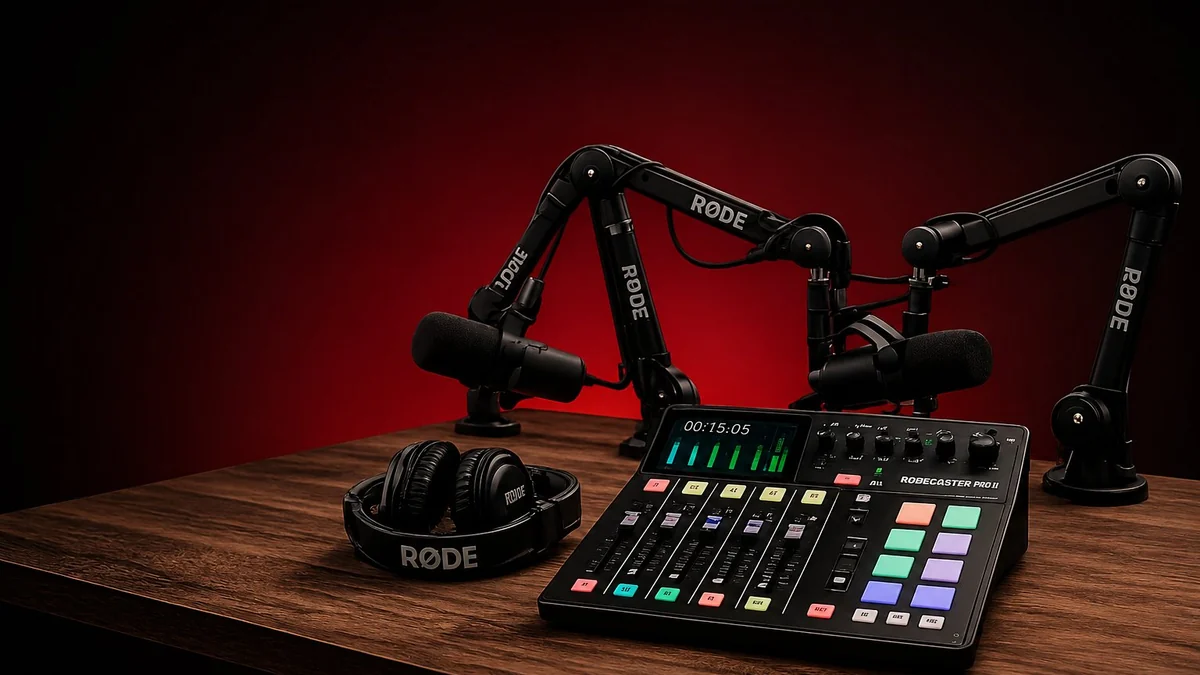
Everything is included at every group size: the four MV7X microphones on boom arms, the RODECaster Pro II, individual headphone monitoring for each guest, 4K multi-camera video, acoustic treatment, and your show branding on the studio screen behind you.
A Short Checklist Before a Multi-Person Episode
- Confirm your on-mic count. Four maximum in the room. Anyone else goes remote.
- Name a host. With three or more voices, someone has to direct traffic.
- Tell us about remote guests in advance so we have the platform open and tracks armed before you arrive.
- Count your non-recording guests separately. Up to two, and they do not take a microphone position.
- Brief your guests on microphone discipline. Stay roughly a fist away, do not drift, and let people finish.
Frequently Asked Questions
How many people can you have on a podcast?
As many as you have microphones for. At Red Mile Records that is four on mic, plus up to two non-recording guests in the room, plus anyone else joining remotely on their own recorded track.
How many microphones do you need for a 4 person podcast?
Four, one per person. Sharing a microphone puts two voices on one track permanently, so you lose the ability to fix one person's level without affecting the other.
Can guests join a podcast remotely?
Yes. We run hybrid sessions through Zoom, Riverside, SquadCast or Cleanfeed, and each remote participant is recorded on a separate track so they can be edited independently.
Do non-recording guests count toward the limit?
No. On-mic participants and non-recording guests are counted separately. Up to two non-recording guests can attend in addition to your on-mic lineup.
Is four people too many for one episode?
Four works when someone is clearly hosting. Without a host directing the conversation, four voices tend to overlap and the episode gets hard to follow and hard to edit. Three is the easiest size to run well.
The Takeaway
Stop thinking about guest limits as a rule and start thinking about them as channels. Four microphones means four voices with full independent control. Two more people can be in the room. Everyone else joins remotely and still gets their own track. That covers almost every episode anyone actually wants to make.
If you are planning a panel episode and want to talk through the setup first, book at redmilerecords.com/booking, call (587) 330-0918, or email [email protected]. Our podcast studio page has the full gear list.