If you want the short version: loudness is not a number you chase, it is a result you earn from a clean mix and a master built for the song. I run Red Mile Records in Calgary's Beltline, and I master tracks for local artists every week. The question I get most is some version of "why is my song quieter than the stuff on the playlist?" This guide answers that properly, with the real targets, the real traps, and how to prep a mix that actually gets loud without falling apart.
What loudness actually measures
Loudness is how intense your track feels to a listener over time, not the height of a single peak. The industry measures it in LUFS, short for Loudness Units Full Scale. A peak meter tells you the tallest single sample in your file. LUFS tells you how loud the human ear perceives the whole song. Two tracks can both peak at 0 dB and feel worlds apart in volume, because one holds energy across the whole arrangement and the other spikes and drops.
There are three LUFS readings worth knowing. Momentary loudness covers the last 400 milliseconds. Short-term covers the last 3 seconds. Integrated loudness measures the entire track start to finish, and that integrated number is the one streaming platforms read when they decide how to play you back.
The streaming targets, platform by platform
Every major platform normalizes playback so listeners do not have to ride the volume knob between songs. Each one turns your track up or down toward its own reference level. As of 2026 the common targets are:
- Spotify: around -14 LUFS integrated on the default Normal setting. The Loud setting plays nearer -11.
- Apple Music (Sound Check): around -16 LUFS.
- YouTube: around -14 LUFS.
- Amazon Music and Tidal: around -14 LUFS.
Here is the part that confuses people. These platforms only turn loud masters down. They do not meaningfully turn quiet masters up to match, and when they do apply gain they will not push past your true peak ceiling. So a track mastered at -16 LUFS does not magically become as punchy as one mastered hot. It just plays quieter and flatter than the songs around it.
The -14 LUFS myth
The advice you have read a hundred times says master to -14 LUFS so you match Spotify. I disagree with how that gets taught, and so does almost every mastering engineer working on records you know. Most commercial masters sit far louder than -14, often between -8 and -10 LUFS integrated depending on genre. Hip hop, pop, and electronic push louder. Folk, jazz, and classical sit quieter on purpose because dynamics are the point.
When Spotify turns a -9 LUFS master down to its reference level, that master still sounds dense, controlled, and full, because the loudness was built into the mix, not slapped on at the end. A track mastered timidly to -14 will sound thin and far away next to it even after normalization. Master for what the song and the genre need, then let normalization do its job. We treat every master that way in our Calgary mixing and mastering work.
True peak is the rule you cannot break
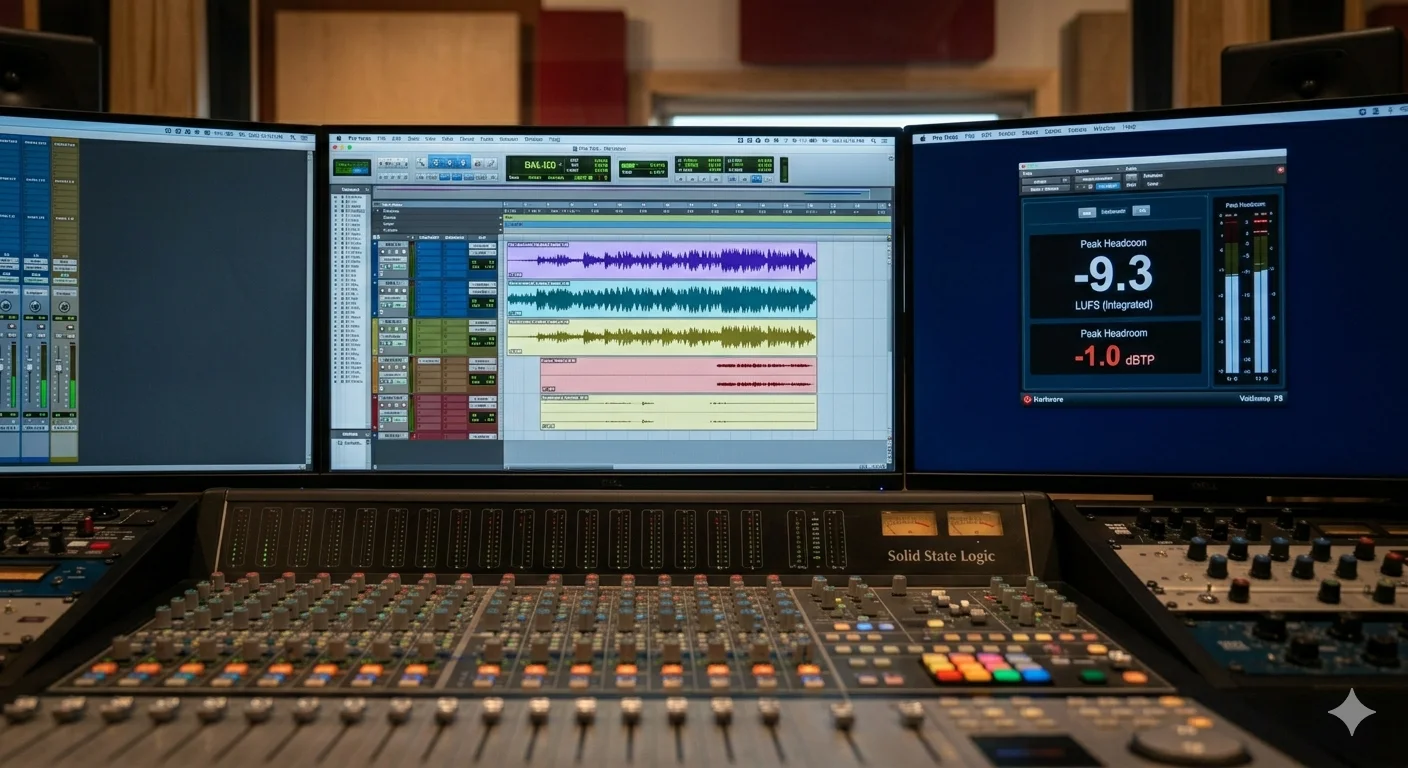
Loudness is flexible. Your true peak ceiling is not. Deliver masters at -1 dBTP (decibels true peak), and for heavily compressed lossy formats I will sometimes pull it to -1.5 dBTP. The reason is technical and unforgiving. When a platform encodes your WAV into a lossy format like Ogg Vorbis or AAC, the conversion can create inter-sample peaks that overshoot your original level. If your master already kisses 0.0 dB, those overshoots clip, and clipping on a streamed file sounds like crunchy, fizzy distortion that you cannot take back. That -1 dB of headroom is your insurance.
Why pro masters get loud without sounding crushed
Loudness that survives is built from the bottom up, long before the limiter. The signal chain matters. We track vocals through a Neumann U87 Ai or TLM 103 into a Neve 1073LB and an Avalon 737SP, then a Universal Audio Apollo X6, because a clean, detailed capture leaves room to push level later. A muddy recording fights you at every stage. Here is what creates loud, clean masters in order of importance:
- Arrangement and performance. Parts that fight for the same frequency space cancel and muddy. A tight arrangement is already half-loud.
- A controlled low end. Bass and kick eat headroom faster than anything. If your sub is wild, your limiter works overtime and the whole track pumps.
- Balanced mix levels. Loudness done in the mix, by riding faders and controlling dynamics, beats loudness forced by a limiter every time.
- Gentle, staged compression. Several small gain reductions across the chain sound natural. One brutal squash sounds dead.
- A transparent limiter, last. The limiter sets the final ceiling. It should be the finishing touch, not the rescue.
How to prep your mix so it masters loud
If you are sending a mix to a mastering engineer, or to us, give the master room to work:
- Leave headroom. Bounce your mix peaking around -6 dB. You are not losing quality, you are giving the master space.
- Do not slap a limiter across your master bus and crush it before you export. Pull it off, or leave it gentle.
- Fix the low end in the mix, not at the master. No limiter can clean up a boomy 80 Hz buildup.
- Export a 24-bit WAV at your session sample rate. Skip the MP3.
- Trust your ears over the meter. Meters confirm what you hear. They do not hear for you.
Loudness is the last link in a chain that starts with the room and the mic. If you want the full picture of why the recording stage decides everything that comes after, read why professional mixing and mastering is non-negotiable for Spotify, and our take on what makes a studio recording the best today. Once your master is right, the next job is getting it heard, which we cover in how to get more Spotify listeners.
About the author: Matthew Redenbach is the owner and engineer at Red Mile Records, a professional recording, mixing, and mastering studio at 1865 17 Ave SW in Calgary's Beltline. He has mixed and mastered releases for Calgary and national artists including Matthew Douglas, JRDN, and Jhrted.
Frequently asked questions about loudness
What LUFS should I master to in 2026?
Master to what the song and genre need, not to a single number. Most modern pop, hip hop, and electronic masters land between -8 and -10 LUFS integrated, while acoustic and jazz sit quieter to keep their dynamics. Set a true peak ceiling of -1 dBTP and let each platform normalize from there.
Will Spotify turn my quiet song up to -14 LUFS?
No. Spotify reliably turns loud masters down toward its reference level, but it does not push quiet masters up to match, and it never exceeds your true peak ceiling. A timid master simply plays quieter and flatter than the louder tracks around it.
Why does my master distort after I upload it?
Almost always inter-sample peaks. When the platform encodes your file to a lossy format, the conversion creates peaks slightly higher than your original. If your master peaks at 0.0 dB, those overshoots clip. Deliver at -1 dBTP to leave a safety buffer.
Can I get a loud master from a home recording?
Up to a point. Loudness that holds together is built from a clean capture and a controlled low end. A muddy or distorted recording will fight the limiter and pump. A treated room and a proper signal chain, like our Calgary recording studio setup, give the master far more to work with.
While you are working on your mix, try our free BPM finder and delay calculator to dial in tempo-synced times.