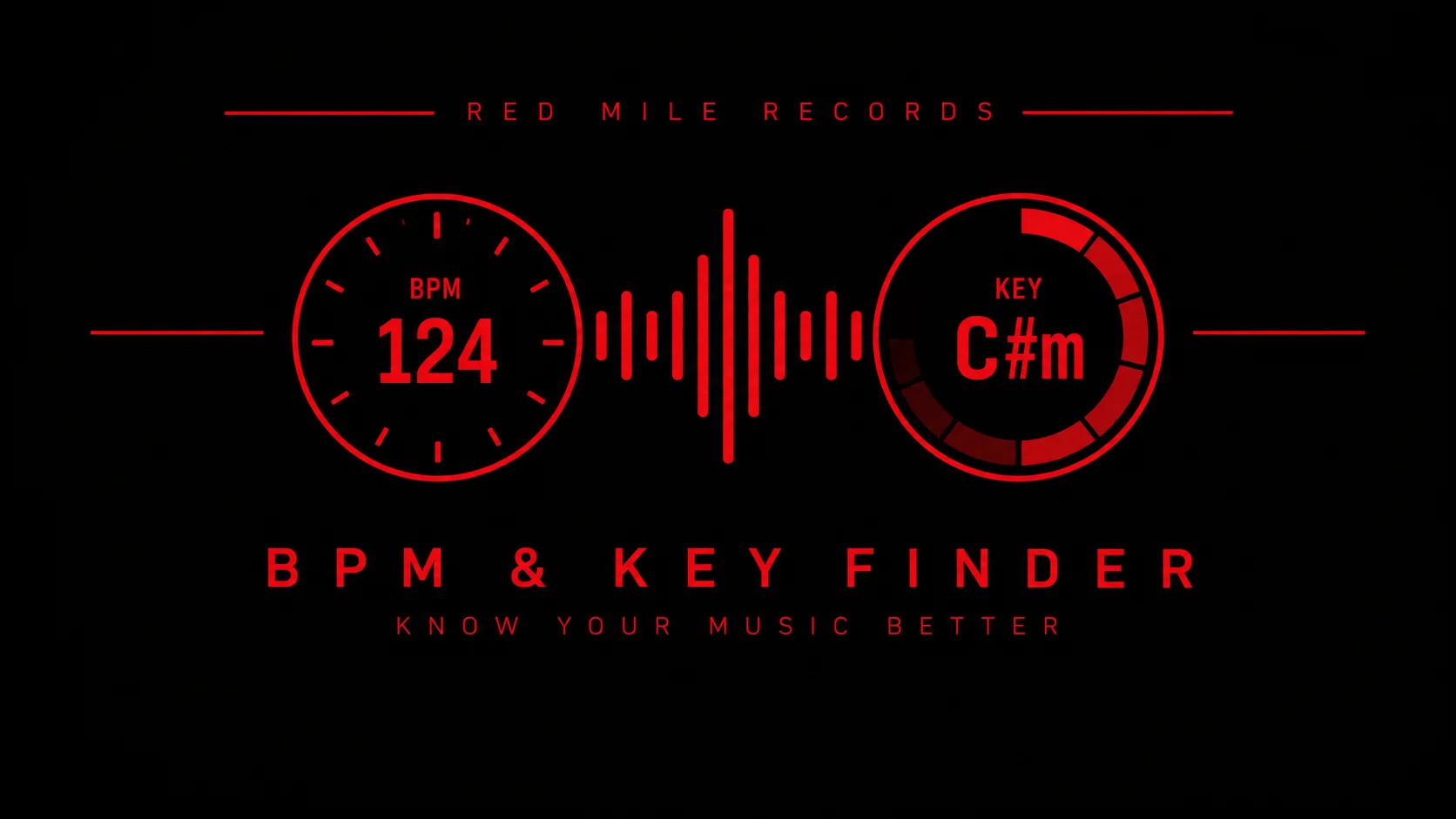
We built a free BPM finder, key detector, and delay/reverb calculator and put it on our website for anyone to use. No signup. No upload to a server. No ads. You drop in a song, it tells you the tempo, the key, the Camelot code, and gives you every delay and reverb timing value you need for your session. Here is how it works and why we built it.
How the BPM Finder Works
The BPM detection runs entirely in your browser using the Web Audio API. When you drop an audio file into the analyzer, the tool decodes it locally on your device, builds an onset map of the waveform, and runs autocorrelation with harmonic reinforcement to find the dominant tempo. It samples at 22,050 Hz with a 2048-point FFT and 256-sample hop size, which gives it enough resolution to detect tempo accurately across genres from slow R&B ballads to fast drum and bass tracks.
The algorithm has a built-in bias toward the 70 to 160 BPM range, which is where most popular music lives. If the detected tempo lands above 160 BPM, the tool checks whether the half-time version scores above 55% confidence and prefers that instead. This prevents the common problem where tools report 140 BPM as 280 BPM or detect a trap beat at 70 BPM as 140.
It also skips the first 15 seconds of any track. Most songs start with sparse intros, ambient textures, or silence that can confuse tempo detection algorithms. By jumping past the intro, the tool analyzes the section where the beat is actually established and delivers a more reliable result.
How the Key Finder Works
Key detection uses chromagram analysis to build a harmonic profile of the track, then matches it against all 24 major and minor key profiles. The algorithm applies a low-frequency cutoff at 130 Hz, which is critical for accurate key detection on bass-heavy music. Without this cutoff, 808 sub-bass and kick drums can dominate the chroma analysis and pull the detected key toward whatever note the bass is sitting on, even when the melodic content is in a completely different key.
The tool also applies octave weighting, giving 2.5 times more weight to frequencies between 250 Hz and 1200 Hz. This is the range where most melodic information lives: vocals, synths, guitars, and pianos. By prioritizing this range, the key detection follows the harmonic content that actually defines the song rather than being skewed by sub-bass or high-frequency percussion.
Once the key is identified, the tool displays both the standard musical key notation (such as C# minor or F major) and the Camelot code that DJs use for harmonic mixing.
What Is the Camelot Wheel
The Camelot system assigns each of the 24 musical keys a number from 1 to 12 and a letter: A for minor keys and B for major keys. Keys that are adjacent on the wheel are harmonically compatible, which means songs in those keys will blend smoothly when mixed. For example, a track in 8A (A minor) will mix cleanly with tracks in 7A, 9A, or 8B (C major).
DJs use the Camelot wheel to plan sets without needing formal music theory. Instead of thinking about intervals and chord progressions, you just match the numbers. Move up or down by one number to change energy gradually. Switch between A and B at the same number to shift from minor to major (or vice versa) without a key clash. Our tool displays the Camelot code alongside every key detection result so you can use it immediately in your set prep.
The Delay and Reverb Calculator
The second half of the tool converts your song's BPM into millisecond timing values for delay and reverb settings. Once you know the tempo, you can calculate exactly how long a quarter-note delay should be, what a dotted eighth delay sounds like at that tempo, or what pre-delay and decay settings will make your reverb sit in the groove of the track.
The calculator outputs timing values for whole notes, half notes, quarter notes, eighth notes, and sixteenth notes in straight, dotted, and triplet divisions. It also provides reverb pre-delay suggestions based on the tempo, so your reverb tail fades naturally between beats instead of smearing across the rhythm.
Why does this matter? When delay and reverb times are not synced to the tempo, effects fight the rhythm of the track. A delay throw that lands slightly off the beat creates a muddy, cluttered mix. A reverb tail that bleeds into the next downbeat washes out transients. Tempo-synced timing values solve both problems. You plug the millisecond value directly into your delay or reverb plugin, and the effect locks to the groove.
Why We Built This Tool
One of Red Mile Records' core values is no gatekeeping. We share knowledge, open doors, and make access free. This tool exists because we use these calculations in every recording and mixing session at our Calgary studio, and there is no reason to keep them behind a paywall or a login screen.
Most free BPM finders online are either ad-supported, require an account, or upload your audio to a server for processing. Some of them are wrappers around the same basic algorithm with a registration gate in front. We did not want that. Our tool runs entirely in the browser. Your audio file never touches a server. There is no tracking beyond what you would expect from a normal website visit.
We also built it with hip-hop, R&B, and trap in mind because that is what we record and mix every day. The 130 Hz low-frequency cutoff in the key detection was specifically tuned to handle 808-heavy production without the bass pulling the detected key off target. Most generic BPM and key finder tools were built for EDM or general pop. Ours was built in a studio that works with rappers and R&B vocalists.
How Producers and DJs Use BPM and Key Data
Producers use BPM and key data to match samples, loops, and vocals to a beat. If you have an acapella in D minor at 95 BPM and a beat in E minor at 92 BPM, you know exactly how much pitch and tempo adjustment is needed to make them work together. Without this data, you are guessing, and guessing leads to tracks that sound slightly off without the listener being able to articulate why.
Mix engineers use the delay and reverb calculator to set time-based effects that are synced to the track's tempo. A quarter-note delay on a vocal at 130 BPM is 461 milliseconds. A dotted eighth at the same tempo is 346 milliseconds. These are not arbitrary numbers. They are derived directly from the tempo so the effect reinforces the rhythm instead of working against it.
DJs use BPM and key data to prep sets. Knowing the tempo lets you plan transitions between tracks that are within a few BPM of each other, reducing the need for aggressive pitch correction. Knowing the key (and the Camelot code) lets you build harmonic journeys through a set where every transition sounds musical rather than random.
How to Use the Tool
Go to redmilerecords.com/tools. Drop an MP3, WAV, FLAC, or M4A file into the analyzer. The BPM and key results appear in seconds. Below the results, the delay and reverb calculator automatically populates with timing values based on the detected tempo. You can also manually enter a BPM if you already know the tempo and just need the timing calculations.
The tool supports files up to 200 MB and works in any modern browser on desktop or mobile. No download, no plugin, no account.
Frequently Asked Questions
How do I find the BPM and key of a song?
Upload an MP3, WAV, FLAC, or M4A file to a browser-based BPM and key finder tool like the one at redmilerecords.com/tools. The analyzer decodes the audio locally, measures the tempo from the waveform using autocorrelation, and identifies the musical key from the harmonic profile. Results appear in seconds.
What is a delay and reverb calculator used for?
A delay and reverb calculator converts your song's BPM into millisecond timing values for delay throws and reverb pre-delay and decay settings. When these timing values are synced to the tempo, effects sit in the groove of the track instead of clashing with the rhythm. Producers and mix engineers use these values to set quarter-note delays, dotted eighth delays, triplet delays, and tempo-matched reverb tails.
Is the Red Mile Records BPM finder really free?
Yes. The BPM finder, key detector, and delay/reverb calculator are completely free with no signup, no upload to a server, and no ads. Your audio file is analyzed entirely in your browser and never leaves your device.
How accurate are online BPM and key finders?
Most browser-based BPM finders are reliable within 1 to 2 BPM for tracks with a clear beat. Key detection is generally accurate for songs with strong harmonic content but can be less reliable with heavily distorted or atonal material. The Red Mile Records tool uses autocorrelation with harmonic reinforcement for BPM and octave-weighted chroma analysis with a 130 Hz low-frequency cutoff for key detection, which improves accuracy on bass-heavy genres like hip-hop and trap.
What is the Camelot wheel?
The Camelot wheel is a system that assigns each musical key a number and letter code from 1A through 12B. Keys that are adjacent on the wheel are harmonically compatible, meaning songs in those keys blend smoothly when mixed. DJs use Camelot codes to plan harmonic transitions without needing music theory. A song in 8A (A minor) mixes well with 7A, 9A, or 8B (C major).
What is the best BPM finder for hip-hop beats?
For hip-hop and trap, you need a BPM finder that handles sub-bass without confusing low frequencies with tonal information. The Red Mile Records tool includes a 130 Hz low-frequency cutoff in key detection and octave-error correction in BPM detection, both designed for 808-heavy production. It also skips the first 15 seconds to avoid sparse intros that can throw off detection.